Games Authority
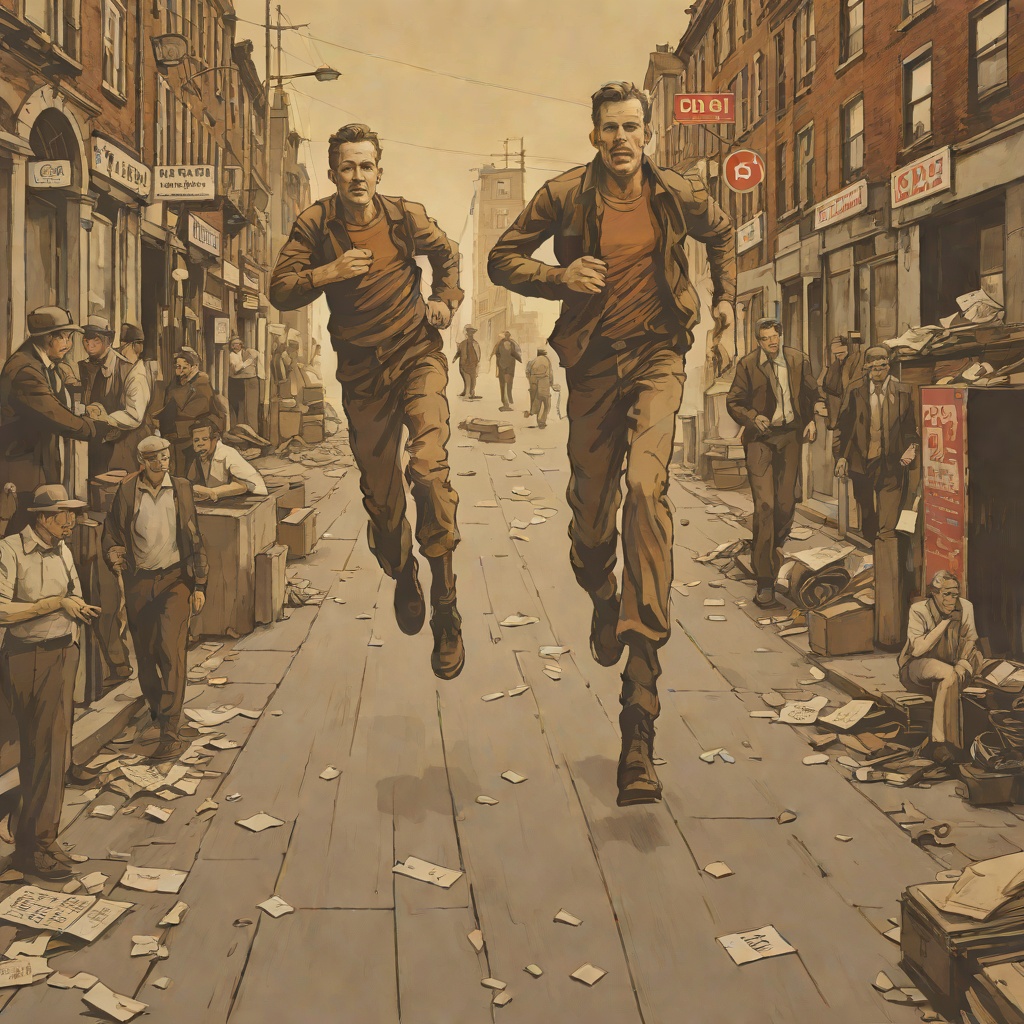
The Running ManGames Authority is the bureaucratic and commercial institution governing The Running Man, a television spectacle in which a financially desperate contestant is given a head start and then exposed to a nationwide hunt. Its decisive function is not merely to stage a dangerous program but to make coercion appear contractual, violence appear entertaining, and public participation appear civic. Through Dan Killian’s office, Games Authority joins recruitment, payment, surveillance, editing, publicity, and enforcement into one system.
Institutional Identity and Recruitment
Games Authority presents Ben Richards with the language of employment and entertainment. Dan Killian identifies himself as the executive producer of The Running Man and tells Richards that the program is the Network’s largest and most lucrative show, while also being the most dangerous for its contestants. The institution’s records and Richards’s test scores have marked him as intelligent, and Killian frames that classification as the reason for his selection. Yet the supposedly flattering assessment conceals a political judgment: Killian describes Richards as the sort of embryo troublemaker the Network wants to eliminate. Games Authority therefore treats intelligence, dissent, and economic vulnerability as linked administrative categories.
The formal consent document gives the arrangement a legal surface. Killian expects Richards to sign the final consent form, but the surrounding circumstances make the voluntariness of that signature doubtful. Richards needs money for his family, especially for Catherine Sarah Richards’s medical care, and Sheila Richards resists accepting what she sees as blood money even while the household lacks access to a real doctor and modern equipment. The institution does not need to force Richards physically into the office; it makes the alternative to participation increasingly unbearable. Its contract is consequently less a free choice than a mechanism for converting poverty into usable labor.
Rules, Payments, and Enforcement
The program’s rules reduce survival to a precise financial calculation. Richards, or his surviving family, is promised one hundred New Dollars for every hour he remains free. Games Authority advances forty-eight hundred dollars as running money on the assumption that he can evade the Hunters for forty-eight hours, with the unused balance supposedly refundable if he is killed earlier. He receives a twelve-hour head start, while survival for thirty days carries a Grand Prize of one billion New Dollars. The huge figures give the arrangement the glitter of opportunity, but the institution’s record makes the wager function as a death sentence: Killian says that after six years the program has had no survivors and that none are expected.
Games Authority also controls the contestant’s labor after he leaves the studio. Richards is given a compact tape machine, weighing six pounds and small enough to fit in a coat pocket, together with sixty tape clips. He must deposit two clips per day in a mailslot so that they can be delivered for editing and broadcast that night. Failure to submit the required material constitutes legal default of payment. The rule exposes the program’s double demand: Richards must evade the Hunters in physical space while continuously producing the content that makes his own pursuit saleable. The technology does not free him from the institution; it extends the institution’s reach into his movements.
The payment system is equally controlled. Killian offers Richards a personal loan equal to ten percent of his advance salary, not in New Dollars but in Games Certificates redeemable for dollars. The forty-eight coupons, each worth ten New Dollars, are presented as useful because a reputable doctor will accept them as legal tender, even if a quack will not. The offer appears charitable, yet Richards recognizes that Killian can charge the four hundred and eighty dollars against his advance. Games Authority thus monetizes even an emergency medical need, making the family’s access to legitimate care part of the program’s financial architecture.
The institution further rewards violence and delegates enforcement. Richards or his estate will receive an additional one hundred dollars for every Hunter or representative of the law he kills, although Killian warns him not to harm innocent bystanders because that would be bad theater. Anyone who reports a verified sighting receives one hundred New Dollars; a sighting resulting in a kill pays one thousand. Independent cameramen receive ten dollars a foot and more for usable footage. Games Authority transforms citizens into informants, witnesses into bounty hunters, and photographers into piece-rate contractors, while preserving the language of entertainment around the resulting bloodshed.
Broadcast Framing and Public Participation
Games Authority’s power depends on controlling not only what happens but how the public understands what happens. At the opening broadcast, Bobby Thompson introduces Richards as Benjamin Richards, a terrifying urban predator from south of the Canal. A hidden-camera portrait has been retouched to deepen his eyes, lower his forehead, shadow his cheeks, and curl his mouth into a primitive, threatening expression. Sheila’s image is similarly altered, turning her into a caricature of greed and sexual vulgarity. The family is not merely displayed; it is graphically rewritten so that viewers can regard the contestant and his household as moral objects rather than people under economic pressure.
Thompson’s studio performance converts spectatorship into a direct financial relationship with violence. Viewers are told that a verified sighting is worth one hundred New Dollars and that a kill is worth one thousand. When Richards attempts to correct the false image of his wife, the audience drowns him out with screams of hatred. The broadcast’s apparent spontaneity is therefore structured by controlled images, incentives, crowd management, and the host’s authority to decide when Richards may speak. Games Authority makes public opinion part of the hunt before the physical pursuit has fully begun.
The same machinery continues in later programming. Thompson calls Richards one of the wolves who walk among ordinary people and accuses him of having killed five policemen at the Boston Y.M.C.A. The program then presents a still image of the young officers and accompanies it with Taps, arranging grief so that the officers become innocent symbols and Richards becomes their chosen opposite. When Richards’s recorded appeal about libraries, pollution, and public research is shown, his words are manipulated into obscene threats against police and the Games Commission. The split-screen juxtaposition of Thompson and Richards’s still image gives the institution a ready-made moral frame: Thompson speaks as public judgment, while Richards appears as the proof of the accusation.
The editing process makes truth subordinate to circulation. Richards sees his image paired with the John Griffen Springer disguise, while another clip appears to make him threaten murder through altered or spliced audio. The audience is not asked to investigate the discrepancy; it is supplied with a sequence whose emotional meaning has already been fixed. Games Authority’s broadcast is therefore a form of narrative enforcement. It does not simply report a manhunt but produces the identity that justifies it.
Institutional Logic and Contradictions
Games Authority claims that the contestant is a working man rather than a Free-Vee star, insisting that the danger is a job for which he is being paid extremely well. At the same time, it surrounds that job with the spectacle, prizes, celebrity framing, and viewer participation associated with mass entertainment. This contradiction is central to the institution’s operation. Richards is denied the protections and dignity of a performer while being required to generate the dramatic material of a star. He is labor, product, and target at once.
The institution also presents its violence as orderly. The payment schedule, the head start, the tape quota, the bounty structure, and the legal default clause make the hunt resemble a regulated game. Yet the regulation does not make the contest fair. Games Authority expects no survival, encourages armed resistance when it increases spectacle, pays outsiders to expose the contestant, and can interrupt scheduled broadcasting when a contestant approaches a personal Waterloo. Its rules are not neutral boundaries around a contest; they are procedures for maintaining attention and maximizing the probability that pursuit will become profitable drama.
This logic reaches its most extreme visible expression when Richards claims to be carrying twelve pounds of Black Irish explosive at the jetport, fitted with a General Atomics imploder ring. His threat causes the crowd to flee and leaves police unwilling to dismiss the claim. The scene reveals the reversal at the heart of Games Authority’s system: an institution that normally governs danger through cameras, contracts, rewards, and armed pursuers can itself be forced to respond to danger as a spectacle of uncertainty. Richards uses the institution’s own appetite for credible threat against it, turning the audience’s fear and the authorities’ need to keep the show legible into temporary leverage.
Consequences and Narrative Significance
Games Authority’s most consequential achievement is the fusion of personal crisis with public entertainment. The need for medical treatment in the Richards household becomes a recruitment pressure; the family’s poverty becomes a prize calculation; the contestant’s speech becomes editable footage; and every sighting becomes a paid transaction. Even the possibility that the Network had no direct role in the deaths of Sheila Richards and Catherine Sarah Richards is presented through Killian’s institutional position and the suspicion that an hour on the streets of Co-Op City would reveal the truth. Games Authority’s power lies partly in this uncertainty: it can deny responsibility while controlling the structures through which responsibility is interpreted.
The organization’s methods also expose a broader social arrangement in which information, mobility, and violence are administered together. It uses Free-Vee to define the enemy, postal infrastructure to collect compulsory recordings, citizens to extend surveillance, police and Hunters to enforce the pursuit, and financial certificates to regulate access to care. The program’s most chilling feature is not that it breaks rules, but that it uses rules to make exploitation look measurable and therefore legitimate.
Within the narrative, Games Authority functions as the institutional antagonist behind the visible antagonists. Bobby Thompson supplies the voice of contempt, the Hunters supply the physical pursuit, and Killian supplies the administrative smile, but the organization makes all three roles interoperable. Its recurring language of opportunity, consent, payment, and audience participation steadily strips those words of their ordinary meaning. The result is a portrait of an entertainment authority that does not merely stage a manhunt: it manufactures the social reality in which a desperate man can be hunted for profit and the public can be taught to call that hunt a game.